"""
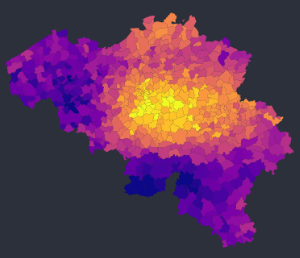
Module for geographical visualization (geomapviz)
"""
# Settings and libraries
from __future__ import print_function
from mpl_toolkits.axes_grid1 import make_axes_locatable
from typing import Optional, Union, Tuple, List, Dict
# pandas
import pandas as pd
import geopandas as gpd
from mapclassify import FisherJenks
from dataclasses import dataclass
# numpy
import numpy as np
import math
# Plot and graphics
import seaborn as sns
import matplotlib as mpl
import matplotlib.pyplot as plt
from matplotlib.colors import Normalize
import cartopy.crs as ccrs
import holoviews as hv
import geoviews as gv
from holoviews import opts
import contextily as cx
from .aggregator import dissolve_and_aggregate
hv.extension("bokeh", logo=False)
hv.renderer("bokeh").theme = "light_minimal"
sns.set(style="ticks")
__all__ = ["spatial_average_plot", "spatial_average_facetplot", "PlotOptions"]
def dark_or_light_color(color: str):
"""Determine whether a given color is light or dark.
Parameters
----------
color :
A color represented as a string in any valid matplotlib format.
Returns
-------
str
Either 'light' or 'dark', depending on whether the given color is
light or dark.
Raises
------
ValueError
If the given color is not a valid matplotlib color.
Examples
--------
>>> dark_or_light_color('red')
'dark'
>>> dark_or_light_color('#FFFFFF')
'light'
>>> dark_or_light_color('invalid_color')
Traceback (most recent call last):
...
ValueError: Invalid RGBA argument: 'invalid_color'
"""
[r, g, b] = mpl.colors.to_rgb(color)
hsp = math.sqrt(0.299 * (r * r) + 0.587 * (g * g) + 0.114 * (b * b))
if hsp > 127.5:
return "light"
else:
return "dark"
def set_decimal_precision(nbr_of_dec: str = 2, bins: Optional[np.ndarray] = None):
"""
Set the decimal precision based on the number of decimal points in `nbr_of_dec`
or based on the minimum absolute value in `bins` if `nbr_of_dec` is not provided.
Parameters
----------
nbr_of_dec :
Number of decimal points to use.
bins :
Input array of bins.
Returns
-------
str
String representation of the number of decimal points to use.
"""
if nbr_of_dec is not None:
nbr_dec = str(nbr_of_dec)
elif (bins is not None) and (np.abs(bins).min() < 1):
nbr_dec = str(4)
else:
nbr_dec = str(2)
return nbr_dec
def calculate_bins(
df: pd.DataFrame,
target: str = "avg",
cols_to_bin: Optional[List[str]] = None,
n_bins: int = 7,
autobin: bool = False,
normalize: bool = False,
) -> Dict[str, Optional[np.ndarray]]:
"""
Calculate the bin edges for each specified column in a given dataframe.
Parameters
----------
df :
The input dataframe.
target :
The column to use as the target for binning (default is 'avg').
cols_to_bin :
The list of columns to calculate the bin edges for (default is None).
If None, the bin edges will be calculated for all columns in the dataframe.
n_bins :
The number of bins to create (default is 7).
autobin :
Whether to automatically calculate the bin edges using Fisher-Jenks optimization (default is False).
normalize :
Whether to normalize the data before calculating the bin edges (default is False).
Returns
-------
Dict[str, Optional[np.ndarray]]
A dictionary mapping each column name to its corresponding bin edges.
If autobin is False, the value for each column will be None.
"""
if cols_to_bin is None:
cols_to_bin = []
bins_dict = {}
for col in cols_to_bin:
if autobin:
bins = (
FisherJenks(df[target].fillna(0), n_bins).bins
if normalize
else (
FisherJenks(df[col].fillna(0), n_bins).bins
if df[col].nunique() > n_bins
else None
)
)
else:
bins = None
bins_dict[col] = bins
return bins_dict
def create_norm(
df: pd.DataFrame, ref_col: str = "avg"
) -> Tuple[Normalize, float, float]:
"""
Calculate the normalization for a color map based on the percentiles of a reference column.
Parameters:
-----------
df:
The data used to calculate the percentiles and normalization.
ref_col:
The name of the reference column in the dataframe.
Returns:
--------
norm: mpl.colors.Normalize
The normalization object for the color map.
vmin: float
The minimum value of the percentile range.
vmax: float
The maximum value of the percentile range.
"""
# Calculate the 1st and 99th percentiles of the reference column
vmin, vmax = np.nanpercentile(df[ref_col].fillna(0), [1, 99])
# Create a normalization object using the percentile range
norm = Normalize(vmin=vmin, vmax=vmax)
return norm, vmin, vmax
def create_cbar(ax: plt.Axes, title_col: str):
"""
Create a colorbar axis to the right of the given axis.
Parameters
----------
ax :
The axis to add the colorbar to.
title_col :
The color of the colorbar title.
Returns
-------
cax : plt.Axes
The created colorbar axis.
"""
divider = make_axes_locatable(ax)
cax = divider.append_axes("right", size="5%", pad=0.1)
cax.tick_params(
axis="y",
labelsize="large",
labelcolor=title_col,
grid_linewidth=0,
color=title_col,
)
cax.set_frame_on(False)
return cax
[docs]@dataclass
class PlotOptions:
"""Options for generating a thematic map using Matplotlib.
Parameters
----------
df : pd.DataFrame
The pandas DataFrame containing the data to plot.
target : str
The column name of the target variable to plot.
other_cols_avg : Optional[str], optional
The column name of other columns in the dataframe to be averaged and plotted against the target variable, by default None.
weight : Optional[np.ndarray], optional
An array of weights for each observation, by default None.
plot_weight : bool, optional
A boolean flag indicating whether to plot the weights on the map, by default False.
dissolve_on : Optional[str], optional
The column name of the column to dissolve on when aggregating geometries, by default None.
geoid : str, optional
The name of the column containing the geographic ID, by default "nis".
shp_file : Optional[gpd.geodataframe.GeoDataFrame], optional
A GeoDataFrame containing the geometry data to plot, by default None.
distr : str, optional
The distribution type to use when calculating bin thresholds for the target variable, by default "gaussian".
plot_uncertainty : bool, optional
A boolean flag indicating whether to plot uncertainty bands around the target variable, by default False.
background : Optional[str], optional
The name of the background map to use, by default None.
figsize : Tuple[float, float], optional
The figure size, by default (12, 12).
ncols : int, optional
The number of columns in the plot grid, by default 2.
cmap : Optional[str], optional
The name of the color map to use for the plot, by default None.
facecolor : str, optional
The background color of the plot, by default "#2b303b".
nbr_of_dec : Optional[int], optional
The number of decimal places to use when displaying values on the plot, by default None.
autobin : bool, optional
A boolean flag indicating whether to automatically calculate bin thresholds for the target variable, by default False.
normalize : bool, optional
A boolean flag indicating whether to normalize the color scale, by default True.
n_bins : int, optional
The number of bins to use when manually calculating bin thresholds for the target variable, by default 7.
interactive : bool
whether to use interactive charts or not.
Returns
-------
PlotOptions
A PlotOptions object containing the input arguments.
"""
# data arguments
df: pd.DataFrame
target: str
other_cols_avg: Optional[str] = None
# weights arguments
weight: Optional[np.ndarray] = None
plot_weight: bool = False
# geospatial arguments
dissolve_on: Optional[str] = None
geoid: str = "nis"
shp_file: Optional[gpd.geodataframe.GeoDataFrame] = None
# uncertainty arguments
distr: str = "gaussian"
plot_uncertainty: bool = False
# style arguments
alpha: float = 0.5
background: Optional[str] = None
figsize: Tuple[float, float] = (12, 12)
ncols: int = 2
cmap: Optional[str] = "plasma"
facecolor: str = "#2b303b"
nbr_of_dec: Optional[int] = None
# binning arguments
autobin: bool = False
normalize: bool = True
n_bins: int = 7
# matplotlib or holoviews
interactive = False
def plot_data(
df: pd.DataFrame,
bins_dict: Dict[str, Optional[List[float]]],
ncols: int,
facecolor: str,
cmap: Optional[str],
alpha: float,
cols_to_enum: List[str],
options: PlotOptions,
) -> mpl.figure.Figure:
"""
Plots data for each column in a given DataFrame using the specified bins and other plotting options.
Parameters
----------
df :
The input DataFrame containing the data to be plotted.
bins_dict :
A dictionary where keys are column names and values are lists of bin edges (if column is to be plotted using user-defined bins) or None (if column is to be plotted using equal interval binning).
ncols :
The number of columns to use for plotting the subplots.
facecolor :
The facecolor for the plots.
cmap :
The colormap to use for the plots. If None, use the default colormap.
alpha :
The alpha (transparency) value for the plotted data.
cols_to_enum :
The columns to plot.
options :
The options for plotting the data.
Returns
-------
mpl.figure.Figure
The resulting figure object containing the plotted data.
"""
nrows = 1
if ncols == 4:
nrows, ncols = 2, 2
f, axs = plt.subplots(
ncols=ncols, nrows=nrows, figsize=options.figsize, facecolor=options.facecolor
)
axs = axs.flatten() if ncols > 1 else axs
luminance = dark_or_light_color(options.facecolor)
title_col = "white" if luminance == "dark" else "black"
if options.normalize:
norm, _, _ = create_norm(df=df, ref_col="avg")
# Plot each column in its corresponding axis
for i, col in enumerate(cols_to_enum):
ax = axs[i] if ncols > 1 else axs
bins = bins_dict[col]
if bins is None:
_, vmin, vmax = create_norm(df=df, ref_col=col)
cax = create_cbar(ax=ax, title_col=title_col)
ax = df.plot(
column=col,
ax=ax,
cax=cax,
legend=True,
linewidth=0,
vmin=vmin,
vmax=vmax,
cmap=cmap,
alpha=alpha,
)
if options.normalize:
ax = df.plot(
column=col,
ax=ax,
cax=cax,
legend=True,
linewidth=0,
vmin=vmin,
vmax=vmax,
cmap=cmap,
alpha=alpha,
norm=norm,
)
else:
nbr_dec = set_decimal_precision(options.nbr_of_dec, bins=bins)
ax = df.plot(
column=col,
ax=ax,
legend=True,
linewidth=0,
cmap=cmap,
scheme="user_defined",
alpha=alpha,
classification_kwds={"bins": bins},
legend_kwds={
"facecolor": facecolor,
"framealpha": 0,
"loc": "lower left",
"fmt": "{:." + nbr_dec + "f}",
"labelcolor": "#575757",
},
)
if options.background:
cx.add_basemap(ax, crs=df.crs, source=options.background)
ax.set_axis_off()
ax.set_title(
"2 standard dev." if col == "2target_std" else col, color=title_col
)
return f
[docs]def spatial_average_plot(options: PlotOptions):
"""
Plot data on a map using a GeoDataFrame.
This function loads the data from a DataFrame `df`,
aggregates it by geographic area, and plots the resulting averages
on a map using a GeoDataFrame `shp_file`. The `target` column in `df` is
used as the variable to plot on the map. Other
columns can also be plotted using the `other_cols_avg` parameter.
The `weight` parameter can be used to weight the data.
The `dissolve_on` and `geoid` parameters are used to
group the data by geographic area. The `autobin`, `normalize`, and `n_bins`
parameters control the binning of the data. The `cmap` parameter controls the colormap,
and the `facecolor` parameter controls the color of the plot background. The `plot_weight`
and `plot_uncertainty` parameters control whether to plot the weight and uncertainty data,
respectively. The resulting plot is returned as a matplotlib Figure object.
Parameters
----------
options : PlotOptions
The options for the plot.
Returns
-------
matplotlib.figure.Figure
The resulting figure object.
Raises
------
TypeError
If `shp_file` in `options` is not a GeoDataFrame.
"""
# Validate the shapefile
if not isinstance(options.shp_file, gpd.geodataframe.GeoDataFrame):
raise TypeError("The shapefile should be a GeoDataFrame")
# Load the data and dissolve
geo_df = dissolve_and_aggregate(
df=options.df,
other_cols_avg=None,
target=options.target,
dissolve_on=options.dissolve_on,
geoid=options.geoid,
weight=options.weight,
shp_file=options.shp_file,
distr=options.distr,
)
# Define the colormap and the number of columns
cmap = options.cmap or "plasma"
alpha = 1.0 if options.background is None else 0.65
ncols = 1 + 2 * options.plot_uncertainty + options.plot_weight
# Define the columns to plot and the corresponding bins for each column
cols_to_enum = ["avg"]
weight_name = ["count"] if options.weight is None else ["weight"]
if options.plot_uncertainty:
cols_to_enum += ["ci_low", "ci_up"]
if options.plot_weight:
cols_to_enum += weight_name
bins_dict = calculate_bins(
df=geo_df,
target="avg",
autobin=options.autobin,
cols_to_bin=cols_to_enum,
n_bins=options.n_bins,
normalize=options.normalize,
)
f = plot_data(
df=geo_df,
bins_dict=bins_dict,
ncols=ncols,
cols_to_enum=cols_to_enum,
facecolor=options.facecolor,
cmap=cmap,
alpha=alpha,
options=options,
)
return f
def calculate_bins_grouped_data(
grouped: pd.core.groupby.DataFrameGroupBy,
autobin: bool,
n_bins: int,
normalize: bool,
):
"""
Calculates the bin ranges for a given DataFrame of model averages.
Parameters
----------
grouped :
The grouped data to plot. It should contain a "avg" column to plot as the main feature.
autobin :
Whether to use Fisher-Jenks algorithm to calculate bins based on the target model or not.
n_bins :
The number of bins to use when calculating bins with the Fisher-Jenks algorithm.
normalize :
Whether to use the same bin ranges for all models, or calculate them individually.
Returns
-------
dict
A dictionary containing the calculated bins for each model. Keys are model names, and values are lists
of bin ranges. If a model's value is None, no binning was performed for that model.
"""
bins_dict = {}
target_df = grouped.get_group("target")
ref_bins = FisherJenks(target_df["avg"].fillna(0), n_bins) if autobin else None
for name, group in grouped:
if autobin and normalize:
bins_dict[name] = ref_bins
elif autobin and (group["avg"].nunique() > n_bins):
bins_dict[name] = FisherJenks(group["avg"].fillna(0), n_bins)
else:
bins_dict[name] = None
return bins_dict
def plot_grouped_data(
grouped: pd.core.groupby.DataFrameGroupBy,
nrows: int,
ncols: int,
n_charts: int,
bins_dict: dict,
cmap: Union[str, mpl.colors.Colormap],
alpha: float,
title_col: str,
nbr_of_dec: Optional[int] = None,
facecolor: Optional[str] = None,
background: Optional[str] = None,
figsize: Tuple[float, float] = (10, 10),
normalize: bool = False,
):
"""Plot data grouped by a specified column, using matplotlib subplots.
Parameters
----------
grouped :
The grouped data to plot. It should contain a "avg" column to plot as the main feature.
nrows :
The number of rows of subplots to create.
ncols :
The number of columns of subplots to create.
n_charts :
The number of charts to plot.
bins_dict :
A dictionary with the same keys as the groups in `grouped`, and values
indicating the binning strategy to use for the corresponding group.
If None, the data will be plotted without binning.
cmap :
The colormap to use for the plot.
alpha :
The alpha value to use for the plot.
title_col :
The color of the subplot titles.
nbr_of_dec :
The number of decimal places to use for the legend labels (default is None).
facecolor :
The hex facecolor of the figure (default is None).
background : str or None, optional
The background to use for the plot, as a string representing a basemap (default is None).
figsize : tuple, optional
The size of the figure, as a tuple of (width, height) in inches (default is (10,10)).
Returns
-------
matplotlib.figure.Figure
The resulting matplotlib figure.
"""
f, axs = plt.subplots(
ncols=ncols, nrows=nrows, figsize=figsize, facecolor=facecolor
)
axs = axs.flatten() if ncols > 1 else axs
target_df = grouped.get_group("target")
if normalize:
norm, vmin, vmax = create_norm(df=target_df, ref_col="avg")
for i, (name, group) in enumerate(grouped):
ax = axs[i] if ncols > 1 else axs
bins = bins_dict[name]
if bins is None:
_, vmin, vmax = create_norm(df=group, ref_col="avg")
# vmin, vmax = np.nanpercentile(group["avg"].fillna(0), [1, 99])
cax = create_cbar(ax=ax, title_col=title_col)
ax = group.plot(
column="avg",
ax=ax,
cax=cax,
legend=True,
linewidth=0,
vmin=vmin,
vmax=vmax,
cmap=cmap,
alpha=alpha,
)
if normalize:
ax = group.plot(
column="avg",
ax=ax,
cax=cax,
legend=True,
linewidth=0,
vmin=vmin,
vmax=vmax,
cmap=cmap,
alpha=alpha,
norm=norm,
)
else:
nbr_dec = set_decimal_precision(nbr_of_dec, bins=bins.bins)
group.plot(
column="avg",
ax=ax,
legend=True,
linewidth=0,
cmap=cmap,
scheme="user_defined",
alpha=alpha,
classification_kwds={"bins": bins.bins},
legend_kwds={
"facecolor": facecolor,
"framealpha": 0,
"loc": "lower left",
"fmt": "{:." + nbr_dec + "f}",
"labelcolor": "#575757",
},
)
if background:
cx.add_basemap(ax, crs=group.crs, source=background)
ax.set_axis_off()
ax.set_title(name, color=title_col)
# delete non-used axes
n_subplots = nrows * ncols
if n_subplots > n_charts > 1:
for i in range(n_charts, n_subplots):
ax = axs[i]
ax.set_axis_off()
return f
[docs]def spatial_average_facetplot(options: PlotOptions) -> mpl.figure.Figure:
"""
Create a facet plot of spatial data on a map.
Parameters
----------
options : PlotOptions
An object containing the options for the plot.
Returns
-------
matplotlib.figure.Figure
The figure object containing the plot.
Raises
------
TypeError
If the shapefile is not a GeoDataFrame.
Notes
-----
This function uses the following helper functions: `dark_or_light_color()`, `dissolve_and_aggregate()`,
`calculate_bins_grouped_data()`, and `plot_grouped_data()`.
"""
# Validate the shapefile
if not isinstance(options.shp_file, gpd.geodataframe.GeoDataFrame):
raise TypeError("The shapefile should be a GeoDataFrame")
# Compute the luminance of the facecolor
luminance = dark_or_light_color(options.facecolor)
title_col = "white" if luminance == "dark" else "black"
# Load the data and dissolve
geo_df = dissolve_and_aggregate(
df=options.df,
target=options.target,
other_cols_avg=options.other_cols_avg,
dissolve_on=options.dissolve_on,
geoid=options.geoid,
weight=options.weight,
shp_file=options.shp_file,
distr=options.distr,
)
cols_to_plot = (
[options.target]
if options.other_cols_avg is None
else [options.target] + options.other_cols_avg
)
ncols_to_plot = len(cols_to_plot)
nrows = int(np.ceil(ncols_to_plot / options.ncols))
# Fillna with 0 for the specified columns
geo_df["model"] = geo_df["model"].fillna(0).values
# Define the colormap
cmap = options.cmap or "plasma"
alpha = 1.0 if options.background is None else 0.65
grouped = geo_df.groupby("model")
bins_dict = calculate_bins_grouped_data(
grouped=grouped,
autobin=options.autobin,
n_bins=options.n_bins,
normalize=options.normalize,
)
if options.interactive:
f = plot_grouped_data_interactive(
grouped=grouped,
ncols=options.ncols,
bins_dict=bins_dict,
cmap=options.cmap,
alpha=options.alpha,
nbr_of_dec=options.nbr_of_dec,
background=options.background,
figsize=options.figsize,
normalize=options.normalize,
)
else:
f = plot_grouped_data(
grouped=grouped,
nrows=nrows,
ncols=options.ncols,
n_charts=ncols_to_plot,
bins_dict=bins_dict,
cmap=cmap,
alpha=alpha,
title_col=title_col,
nbr_of_dec=options.nbr_of_dec,
facecolor=options.facecolor,
background=options.background,
figsize=options.figsize,
normalize=options.normalize,
)
return f
def get_tiles(tiles_src: Optional[str]) -> hv.element.tiles:
"""
Get a HoloViews tiles element for a specified tiles source string.
Parameters
----------
tiles_src : str, optional
The tiles source to use. If None, use "CartoLight" as the default.
Returns
-------
hv.element.tiles
The tiles element corresponding to the specified tiles source.
"""
if tiles_src is None:
tiles_src = "CartoLight"
if tiles_src not in hv.element.tiles.tile_sources.keys():
raise ValueError(
f"`tiles_src` should be a string and one of {list(hv.element.tiles.tile_sources.keys())}"
)
return hv.element.tiles.tile_sources[tiles_src]()
def get_interactive_plot_options(
col: str, cmap: Union[str, mpl.colors.Colormap], alpha: float
):
"""
Returns a dictionary of options for an interactive plot.
Parameters
----------
col :
The name of the column to plot.
cmap :
The colormap to use for the plot.
alpha :
The opacity of the plot.
Returns
-------
dict
A dictionary of options for an interactive plot, including the following keys:
- 'tools': list of str, specifying the tools to include in the plot.
- 'width': int, specifying the width of the plot in pixels.
- 'height': int, specifying the height of the plot in pixels.
- 'color': geoviews.dim instance, specifying the column to use for coloring the plot.
- 'cmap': str or matplotlib.colors.Colormap, specifying the colormap to use.
- 'colorbar': bool, specifying whether to show a colorbar.
- 'toolbar': str, specifying the location of the toolbar.
- 'xaxis': None, to disable the x-axis.
- 'yaxis': None, to disable the y-axis.
- 'alpha': float, specifying the opacity of the plot.
- 'title': str, specifying the title of the plot.
- 'clipping_colors': dict, specifying colors to use for clipping values.
"""
return dict(
tools=["hover"],
width=550,
height=450,
color=gv.dim("avg"),
cmap=cmap,
colorbar=True,
toolbar="above",
xaxis=None,
yaxis=None,
alpha=alpha,
title=col,
clipping_colors={"NaN": "white"},
)
def get_facet(
df: pd.DataFrame,
tiles: hv.element.tiles,
vmin: float,
vmax: float,
plot_opts: dict,
cbar_labels: Optional[list] = None,
) -> hv.core.overlay.Layout:
"""
Create a choropleth map from a DataFrame of polygon geometries and their corresponding data.
Parameters:
-----------
df :
A DataFrame containing polygon geometries and their corresponding data.
tiles :
A GeoViews element specifying the map tiles to use as the background.
vmin :
The minimum value to use for the color bar.
vmax :
The maximum value to use for the color bar.
plot_opts :
A dictionary of options to pass to the GeoViews element for styling the map.
cbar_labels :
A list of labels for the color bar. If provided, the color bar will be discrete with the
given labels as the major tick labels.
Returns:
--------
facet : gv.core.overlay.Element
A GeoViews element containing the choropleth map overlaid on the specified map tiles.
"""
polygons = gv.Polygons(
df, vdims=[hv.Dimension("avg", range=(vmin, vmax))], crs=ccrs.GOOGLE_MERCATOR
).opts(**plot_opts)
if cbar_labels:
polygons.opts(
colorbar_opts={"major_label_overrides": cbar_labels},
color_levels=len(cbar_labels),
)
facet = tiles * polygons
return facet
def plot_grouped_data_interactive(
grouped: pd.core.groupby.DataFrameGroupBy,
ncols: int,
bins_dict: dict,
cmap: Union[str, mpl.colors.Colormap],
alpha: float,
nbr_of_dec: Optional[int] = None,
background: Optional[str] = None,
figsize: Tuple[float, float] = (10, 10),
normalize: bool = False,
):
"""Plot data grouped by a specified column, using matplotlib subplots.
Parameters
----------
grouped :
The grouped data to plot. It should contain a "avg" column to plot as the main feature.
nrows :
The number of rows of subplots to create.
ncols :
The number of columns of subplots to create.
n_charts :
The number of charts to plot.
bins_dict :
A dictionary with the same keys as the groups in `grouped`, and values
indicating the binning strategy to use for the corresponding group.
If None, the data will be plotted without binning.
cmap :
The colormap to use for the plot.
alpha :
The alpha value to use for the plot.
title_col :
The color of the subplot titles.
nbr_of_dec :
The number of decimal places to use for the legend labels (default is None).
facecolor :
The hex facecolor of the figure (default is None).
background : str or None, optional
The background to use for the plot, as a string representing a basemap (default is None).
figsize : tuple, optional
The size of the figure, as a tuple of (width, height) in inches (default is (10,10)).
Returns
-------
matplotlib.figure.Figure
The resulting matplotlib figure.
"""
target_df = grouped.get_group("target")
if normalize:
norm, vmin, vmax = create_norm(df=target_df, ref_col="avg")
background = get_tiles(tiles_src=background)
facet_list = []
for name, group in grouped:
plot_opts = get_interactive_plot_options(col=name, cmap=cmap, alpha=alpha)
bins = bins_dict[name]
if bins is None:
if not normalize:
_, vmin, vmax = create_norm(df=group, ref_col="avg")
facet = get_facet(
df=group, tiles=background, vmin=vmin, vmax=vmax, plot_opts=plot_opts
)
facet_list.append(facet)
else:
dum = group.copy()
dum["avg"] = dum["avg"].apply(lambda x: bins(x))
# create a dictionary mapping values to labels
label_dict = dict([(i, s) for i, s in enumerate(bins.get_legend_classes())])
if nbr_of_dec is not None:
dum["avg"] = dum["avg"].round(nbr_of_dec)
# if not normalize:
# _, vmin, vmax = create_norm(df=dum, ref_col="avg")
facet = get_facet(
df=dum,
tiles=background,
vmin=None,
vmax=None,
plot_opts=plot_opts,
cbar_labels=label_dict,
)
facet_list.append(facet)
hvl = (
hv.Layout(facet_list)
.opts(opts.Tiles(width=figsize[0], height=figsize[1]))
.cols(ncols)
)
return hvl